_edited.png)
PUBLIC SAFETY | AERIAL THREAT RESPONSE
When Interception Fails, Who Responds?
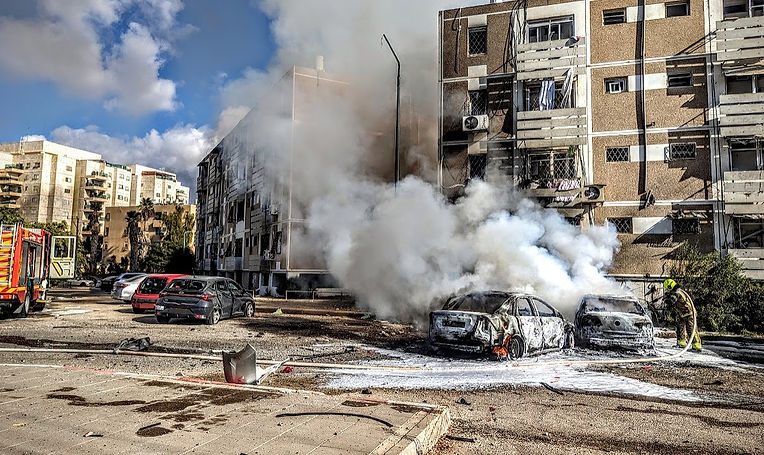
Potomac Strategy trains emergency services to manage the ground-level consequences of aerial attacks: mass casualties, structural collapse, fires, and secondary threats. Our focus is rescue, recovery, and operational continuity, not air defense.
STRATEGIC CONTEXT
A New Threat Landscape
Recent conflicts across the Middle East have seen aerial barrages of hundreds of projectiles per day, including ballistic missiles, cruise missiles, and one-way attack drones launched simultaneously at civilian population centers. Even the most advanced air defense systems cannot achieve 100% interception rates at that volume. What lands creates an immediate, complex emergency on the ground.
For emergency services, this is not a theoretical scenario. A single mass salvo can generate dozens of simultaneous impact sites across a city, overwhelming fire brigades, EMS crews, and civil defense units that were never trained or resourced for this operational tempo. Cascading hazards including structural collapse, secondary fires, unexploded ordnance, and mass casualties compound the challenge within minutes.
Potomac Strategy works exclusively on the rescue and recovery side of this problem. We do not advise on air defense, interception, or weapons systems. Our mandate is to ensure that when the alert sirens stop, the responders who rush toward the scene are trained, coordinated, and capable of operating effectively under conditions that have no precedent in conventional emergency management doctrine.
We also advice on best practices for early warning and shelter protocals.
PROGRAM REVIEW
Training for Police, Fire, EMS, Civil Defense & USAR
Comprehensive Threat Education
Structured understanding of aerial threat typologies, from single-vector incidents to complex multi-layered events. Responders learn to recognize, classify, and prioritize risks in real time.
Practical Response Techniques
Adaptive response methods, responder safety protocols, and operational continuity planning under conditions of ongoing or secondary aerial threats.
Simulated Incident Training
Tabletop exercises and live simulations allowing commanders and frontline personnel to practice command, control, coordination, and execution in high-pressure environments.
Case Studies & Operational Testimony
Drawing on recent incidents across active and near-active theaters, training integrates first-hand accounts from experienced responders and incident commanders, focusing on decision-making under uncertainty.
Safety Protocols & Operational Remedies
Risk mitigation measures for operating at active scenes, including responder protection, crowd management, and multi-agency coordination under evolving threat conditions.
Shelter and Early Warning Protocals
Advise on the creation of civilian and responder shelter and early warning procedures and best practices for during and after attacks.
FORMAT
Customized to Your Agency
Programs run from one to four days and are tailored to jurisdiction-specific risk profiles, operational realities, and agency size. Each engagement is practical, interactive, and built around real-world scenarios.
Who It Is For
Police and law enforcement, fire services, civil defense agencies, emergency medical services, Urban Search and Rescue (USAR) teams, and selected military and security units operating in domestic or civilian contexts.
Subject-Matter Leadership
Our lead instructor brings nearly 20 years of frontline and incident command experience, including direct involvement in multiple aerial threat events. He has delivered confidential briefings and closed-door training for GCC government agencies and has published in the International Fire and Safety Journal and the Journal of Emergency Medical Services on this topic.
PUBLISHED WORK


